Unit Seven

Material World

A complete lesson hub — vocabulary, grammar, reading, listening, communication and writing, all in one place.

GoGetter 4 · Coursebook · Unit 7
Study the words

Flashcards

Practise all the Unit 7 vocabulary with the Quizlet set before the lesson.

Q

Unit 7 — Material World

Flashcards · all key vocabulary · learn, match & test modes

Open Quizlet →
View the slides

Lesson Presentation

Browse the full unit deck — arrows, thumbnails, keyboard ← → keys, or swipe on mobile.
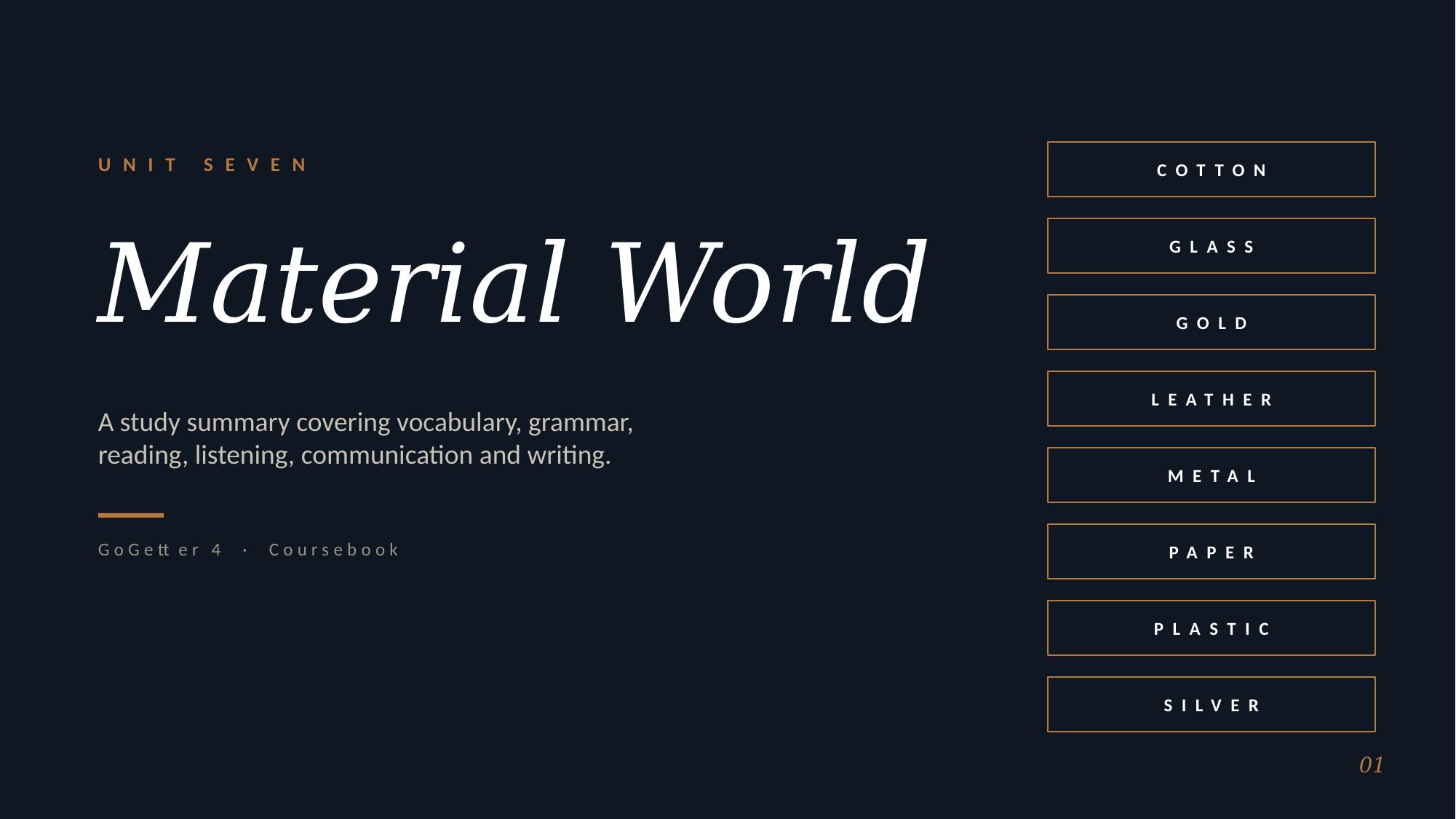
Cover Material World
↓ Slide
Slide 1
1 / 11
Lesson 7.1 · Vocabulary

Materials & how to describe them

Common materials — natural or man-made — and the adjectives we use to describe their properties.

Cotton
Natural
Glass
Man-made
Gold
Natural
Leather
Natural
Metal
Man-made
Paper
Natural
Plastic
Man-made
Silver
Natural
Wood
Natural
Wool
Natural
Adjectives to describe
hardnot soft to the touch
heavyweighing a lot
lighteasy to lift or carry
shinyreflecting light
softgentle, not hard
strongnot easy to break
transparentyou can see through it
Lesson 7.2 · Grammar

Present Simple passive

We use it when the action matters more than the person doing it — or when we don't know who does it.

ACTIVE
FactoriesSubject
produceVerb
the goods.Object
Object → becomes → new Subject
Subject → moves to → by + agent
PASSIVE
The goodsNew Subject
areis / are
producedPast Participle
by factories.by + agent (optional)
Subject–verb agreement
USE "IS"
singular subject → he / she / it / one thing
Gold is found in rivers.
The bag is made of leather.
USE "ARE"
plural subject → they / we / you / many things
Cars are made of metal.
The goods are sold here.
When do we use it?
Doer unknown
My phone was stolen.
We don't know who did it — no need to mention them.
Doer irrelevant
Cotton is grown in Egypt.
The focus is on the cotton, not the farmers.
General facts
English is spoken worldwide.
A universal truth — the doer is "everyone".
Scientific / formal
The mixture is heated slowly.
Formal writing focuses on the process, not the person.
Core formula
subject + is / are + past participle
e.g. Glass is made of sand.
+
Affirmative
Cotton is grown in warm countries.
Add is / are before the past participle.
Negative
These plants aren't grown in cold countries.
Add not after is / are.
?
Question
Where are they grown?
Move is / are before the subject.
Common mistakes
✗  Wrong
✓  Correct
The cars are make in Germany.
base form instead of past participle
The cars are made in Germany.
The windows was cleaned.
wrong form of "be" for plural subject
The windows were cleaned.
The letter was wrote by Ana.
past simple V2 instead of past participle V3
The letter was written by Ana.
It is happened every day.
intransitive verbs can't be made passive
It happens every day.

* happen, arrive, go are intransitive verbs — they can't be made passive.

Quick check

Choose the correct present simple passive form.

Cotton ___ in warm countries.
These bags ___ of leather.
___ English spoken in Australia?
Lesson 7.3 · Grammar

Past Simple passive

For completed past actions — we focus on the object, not the doer.

Form
subject + was / were + past participle ( + by + agent )
Active

A famous artist painted the vase.

The doer (artist) is the subject.

Passive

The vase was painted by a famous artist.

The object (vase) becomes the subject.

Questions & negatives

Was the vase made in China?

The treasures weren't found.

Quick check

Choose the correct past simple passive form.

The vase ___ by a famous artist.
The treasures ___ last year.
Lesson 7.4 · Communication

Asking for clarification

Useful phrases for when you don't catch something, or want to check the other person has understood.

Asking for clarification

Sorry, can you say that again?
Can you repeat that, please?
Could you explain, please?
What do you mean?

Checking understanding

Did you understand that?
Did you get that?
Are you following me?
Lesson 7.5 · Reading

Beautiful things — metals & glass

Beautiful objects can be made from natural metals or man-made materials like glass.

Gold

  • Pure gold (24-carat) is very soft and doesn't change colour over time.
  • Mixed with other metals to make it harder — different mixes create yellow, white or rose gold.
  • Gold has been used in jewellery, coins, and art for thousands of years.
  • It is considered a symbol of wealth and beauty worldwide.

Silver

  • A soft, shiny white precious metal found in nature.
  • Used in jewellery, coins, cups and cutlery for centuries.
  • Many silver objects belonged to royal and noble collections.
  • Silver is also used today in electronics and medical equipment.

Glass

  • A transparent, man-made material originally made from sand.
  • Used in windows, eyewear, mirrors, lamps and art objects.
  • Murano in Venice, Italy is world-famous for its fine decorative glass.
  • Coloured glass has been used in cathedral windows since the Middle Ages.
Lesson 7.6 · Listening & Vocabulary

Technology verbs

Verbs for using devices, plus phrasal verbs with up & down.

chargegive a battery more power
click onpress something on a screen
connectlink two devices together
downloadget a file from the internet
switch offturn a device off
switch onturn a device on
uploadsend a file to the internet

up

often means more / increase
speed upgo faster
turn upmake louder
warm upmake warmer

down

often means less / decrease
slow downgo more slowly
turn downmake quieter
cool downmake cooler
Lesson 7.7 · Writing

Describing a popular product

Use Present & Past Simple passive to describe how a product is made, used and developed.

01

Introduction

  • Name the product you are writing about.
  • Say why you like it or how you use it.
  • End with a question the reader will want answered.
02

History & development

  • When and where was it first produced?
  • What was it originally used for?
  • How has it changed over time?
03

Conclusion

  • Say how popular the product is today.
  • Mention what it is made of.
  • Explain why people still use it.
Example

Sports shoes are used to play basketball. They were invented in England.

Lesson 7.8 · Self-check

Practice & revision

Tick these off as you work through them.

0 of 4 complete

Review the materials vocabulary and describe five everyday objects.

Write five sentences in the Present Simple passive about food, clothes or technology.

Rewrite three active past sentences as Past Simple passive sentences using by.

Practise the clarification phrases out loud in a short dialogue with a partner.